

Ring-necked Duck (Aythya collaris)
In Montréal and across southern Québec, Ring-necked Ducks are most often detected on calm ponds, marsh edges, and sheltered lake sections during early spring migration, when mixed waterfowl groups build in numbers.
At a Glance – Ring-necked Duck
When and where is Ring-necked Duck most reliable around Montréal?
The most reliable pattern is spring migration on deeper, sheltered open water, especially at sites with repeated April records.
- Best timing: Watch shortly after thaw, when open-water conditions draw mixed diving duck groups.
- Best location type: Prioritize deeper calm sections of ponds and lake margins, not very shallow basins.
- Local anchor: Parc de la Frayère is a strong local reference point for repeated April observations.
Why is Ring-necked Duck easy to miss in mixed duck flocks?
Because many birds are at medium to long distance, subtle field marks are often compressed by light and wave glare. Without a scope or stable view, they can blend into mixed duck groups.
- Distance effect: Head shape is easier to use than fine plumage details at range.
- Glare bias: Midday glare can wash out flank and bill contrast.
- Group context: In local observations, they may occur near Bufflehead (Bucephala albeola), so quick comparisons can help avoid rushed IDs.
Is Ring-necked Duck usually close to visitors in city parks?
Usually not; this species is often wary and stays farther offshore or in quieter sections when people are nearby.
- Shy behaviour: Birds often keep distance from paths, docks, and frequent foot traffic.
- Viewing strategy: Scan farther water first, then work inward rather than only checking shoreline edges.
- Disturbance response: Groups may drift outward or reposition after repeated close approach.
Identification and Similar Species
Ring-necked Duck can be tricky at first glance because the namesake neck ring is usually hard to see in field conditions. Prioritize head shape, bill pattern, and contrast instead of expecting a visible collar.
Adult males show a peaked rear crown, dark chest and back, pale grey flanks, and a black bill with a white band near the tip. Females and immatures are subtler brown, with a lighter face pattern and the same compact bill shape.
In my observations, Ring-necked Duck was seen near or within mixed flocks that included Bufflehead (Bucephala albeola). A quick bill cue is a bold white ring near the tip on Ring-necked Duck, while Bufflehead lacks that ring (see photo below).
Photographic Field Records – Québec

Observed Behaviour - Québec (Field Recordings)
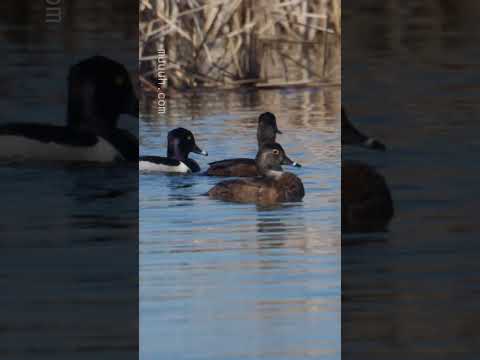
Preening Recorded 2026-04-25 in Parc de la Frayère Ring-necked Duck (Aythya collaris), male and female, preening on open wetland water at Parc de la Frayère recorded during early spring migration.
Best Locations and Seasons for Sightings
In the Montréal region, sightings are currently best documented in spring migration, with local peaks that depend on thaw timing and water levels.
In my records, Ring-necked Duck was observed on multiple occasions in April at Parc de la Frayère, confirming this period as a reliable local spring window.
| Location | Spring | Summer | Autumn | Winter |
|---|---|---|---|---|
| Parc de la Frayère | x | - | - | - |
"x" indicates the species was observed, while "-" indicates no observation. Lack of observation doesn't necessarily imply that the species is absent. Data is derived from my park visit journals.
Fact Sheet
Common Names
| 🇨🇦 | Ring-necked Duck |
| 🇫🇷 | Fuligule à collier |
| 🇩🇪 | Ringschnabelente |
| 🇲🇽 | Pato de collar |
Taxonomy
| Order | Anseriformes |
| Family | Anatidae |
Characteristics
| Length | 39-46 cm |
| Weight | 490-910 g |
| Wingspan | 62-63 cm |
| Clutch Size | 6-14 eggs |
| Incubation | 25-29 days |
| Fledging | 49-56 days |
| Sexual Maturity | 1 year |
Ecology and Behaviour
Distribution
Near Montréal, my best opportunities to observe this species are during the early spring migration window, especially shortly after thaw when deeper, sheltered open water holds mixed diving duck flocks.
Ring-necked Duck winters mainly across the southern United States, Caribbean, and parts of Mexico, then migrates north to breed in boreal wetlands and wooded lakes across Canada (Wikipedia; iNaturalist).
Diet
In my observations at Parc de la Frayère in April 2026, Ring-necked Ducks repeatedly dove in deeper open-water sections during spring migration, and I noticed one female with aquatic vegetation stuck to its beak.
This matches published descriptions of the species as a diving duck feeding on aquatic plant material and invertebrates (All About Birds; Wikipedia).
References – Ring-necked Duck
Most content on this page is based on my direct field observations. General species background (taxonomy, range, and broader ecology) is informed by the sources listed below.
- EOL - Taxonomy and species profile
- iNaturalist - Community sightings and photos
- All About Birds - Identification, behavior, and sounds
- Wikipedia - Broad species overview and background
All content on this page — including photos, videos, and field audio recordings — was created by Karl-Heinz Müller, a Montréal-based wildlife filmmaker, sound recordist, and photographer. Founder of MUUUH and Québec Sauvage, he has spent over a decade documenting Canada’s natural habitats through immersive soundscapes and wildlife films. Learn more about Karl-Heinz
Last updated: 2026-05-26