

White-tailed Deer (Odocoileus virginianus)
In Montréal and across southern Québec, White-tailed Deer are the large mammal visitors most often hope to see in nature parks—especially along forest trails and woodland edges, where year-round residents can appear at close range in some sites.
Coming from Switzerland, my first impression here was how much less shy White-tailed Deer are than the deer I was used to in Europe—behaviour that stands out in parks where people are common.
Do not feed: Maintain distance even when deer appear tame or approach visitors.
At a Glance – White-tailed Deer
Where can I see deer in Montréal?
The most reliable approach is large forested parks on and around the island, not short urban green strips.
- Year-round presence: Deer occur through all seasons; winter often gives the clearest views and thickest coat.
- Habitat type: Prioritize woodland trails, forest edges, and quiet interior paths—not open lawns alone.
- My regular sites: Parc Michel-Chartrand (forest left of the paved walkway), Parc Nature Pointe aux Prairies (forest by the information centre), and Parc de la Frayère (forest right of the road).
When is the best time to look for White-tailed Deer?
They are crepuscular—most active near dawn and dusk—and often rest in cover midday (Wikipedia).
- Winter: Dense winter coat and, in some parks, deer along well-used forest corridors. Give them extra space—low browse under snow means they cannot afford repeated disturbance.
- Spring–summer: Bucks grow antlers through summer; fresh reddish summer coats replace winter pelage.
- Autumn: Rut (breeding season) can increase movement and visibility of bucks.
Are White-tailed Deer usually close to visitors in city parks?
Sometimes, especially where deer are habituated to people—but close approaches are risky for you and the animals.
- Pointe-aux-Prairies in winter: In Parc Nature Pointe aux Prairies, deer in the forest by the information centre may approach visitors expecting handouts. Never feed them—it keeps them dependent on people and raises health and safety risks (see References).
- Winter energy: Food is scarce under snow and ice. Do not approach deer for photos or handouts; flushing them or keeping them on their feet burns calories they need to get through winter.
- Behaviour: Deer may tolerate observers on forest paths; alarmed animals flag the white tail and leave quickly.
Identification and Similar Species
In the Greater Montréal Area, any deer you see is almost certainly a White-tailed Deer—the only deer species commonly present on the island and in nearby parks.
The most reliable field mark is the white underside of the tail, often raised like a flag when the animal is alarmed and runs. At a glance, note a reddish-brown summer coat or a thicker grey-brown winter coat, long slender legs, and a lean build compared with moose.
Males (bucks) usually grow antlers each year (shed in late winter), with a thicker neck especially in autumn. Females (does) are typically smaller and lack antlers.
Similar species (not expected locally)
- Mule Deer — western North America; black-tipped tail, forked antlers, larger ears (Wikipedia).
- Moose — present in Québec but much larger; long legs, bulbous nose, no white tail flag (Wikipedia).
Photographic Field Records – Québec


Observed Behaviour - Québec (Field Recordings)
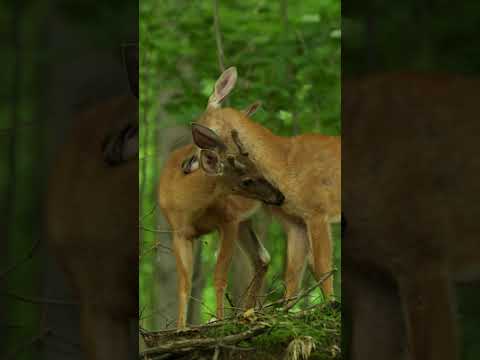
Mutual Grooming Recorded 2024-07-13 in Parc national du Mont-Saint-Bruno Two White-tailed Deer stand close in forest cover while one gently grooms the other, showing calm social contact.

Foraging Recorded 2023-05-13 in Parc nature de la Pointe-aux-Prairies A White-tailed Deer browses quietly through dense spring woodland vegetation, selecting fresh leaves and tender stems at close range.
Best Locations and Seasons for Sightings
In the Montréal region, White-tailed Deer are present year-round, with winter often the most rewarding season for clear views and a full winter coat.
In my records, White-tailed Deer appear year-round in three forested parks where I look for them most often:
- Parc Michel-Chartrand — forest north of the main crossing through the park.
- Parc Nature Pointe aux Prairies — forest near the information centre. In winter, deer there sometimes walk up to people expecting food; do not feed them and do not approach—with little food available, each escape costs energy they need to survive the cold.
- Parc de la Frayère — forest to the right of the entrance road.
Forest trails and edges near cover are the usual places to scan; sightings are never guaranteed on a single visit.
| Location | Spring | Summer | Autumn | Winter |
|---|---|---|---|---|
| Parc Michel-Chartrand | x | - | x | x |
| Parc Mont Saint-Bruno | x | x | - | - |
| Parc de la Frayère | x | - | - | x |
| Parc national du Bic | x | - | - | - |
| Parc Nature Pointe aux Prairies | x | - | - | x |
"x" indicates the species was observed, while "-" indicates no observation. Lack of observation doesn't necessarily imply that the species is absent. Data is derived from my park visit journals.
Fact Sheet
Common Names
| 🇨🇦 | White-tailed Deer |
| 🇫🇷 | Chevreuil |
| 🇩🇪 | Weisswedelhirsch |
| 🇲🇽 | Venado de cola blanca |
Taxonomy
| Order | Artiodactyla |
| Family | Cervidae |
| Subfamily | Capreolinae |
Characteristics
| Length | 180-240cm |
| Weight | 41-136kg |
Ecology and Behaviour
Distribution
Near Montréal, White-tailed Deer occupy deciduous and mixed forest, forest edges, wetland margins, and suburban park woodlands where cover and forage meet open ground (Wikipedia; iNaturalist).
Across their native range they are widespread from southern Canada through the United States into Central America, including all of southern Québec. They adapt well to fragmented and human-influenced landscapes, which helps explain high visibility in Greater Montréal parks (Wikipedia; EOL).
The species is listed Least Concern globally; populations in Québec and the northeast are generally abundant, though local issues include habitat loss, vehicle collisions, and diseases such as chronic wasting disease (Wikipedia).
Diet
White-tailed Deer are generalist herbivores (ruminants) whose diet shifts with the season (Wikipedia).
- Spring and summer: Leaves, forbs, grasses, and soft browse from shrubs and deciduous trees.
- Autumn: Mast (acorns, beechnuts) and fruit where available—important for building fat reserves.
- Winter: Woody browse (twigs, buds), evergreen foliage, and remaining mast when snow limits other food.
In eastern Canada and agricultural margins, they also use crops when accessible. Seasonal coat change (reddish summer, grey-brown winter with insulating guard hairs) supports activity through cold Québec winters (Wikipedia).
References – White-tailed Deer
Most content on this page is based on my direct field observations. General species background (taxonomy, range, and broader ecology) is informed by the sources listed below.
- EOL - Taxonomy and species profile
- iNaturalist - Community sightings and photos
- Wikipedia - Broad species overview and background
- COVID-19 in Quebec Wildlife - Reports of SARS-CoV-2 detected in Québec wildlife, including white-tailed deer
All content on this page — including photos, videos, and field audio recordings — was created by Karl-Heinz Müller, a Montréal-based wildlife filmmaker, sound recordist, and photographer. Founder of MUUUH and Québec Sauvage, he has spent over a decade documenting Canada’s natural habitats through immersive soundscapes and wildlife films. Learn more about Karl-Heinz
Last updated: 2026-05-26